

| EN |


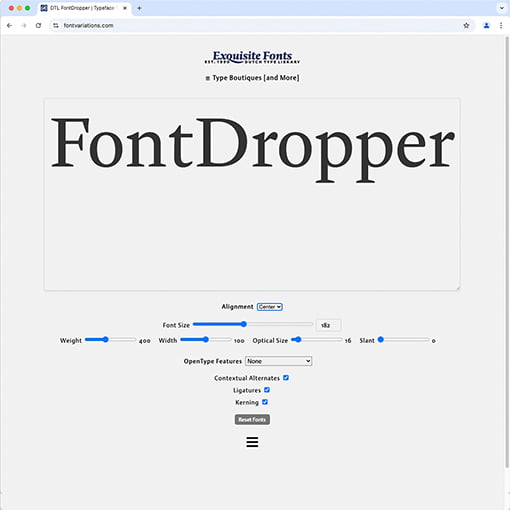
dtl FontDropper
[Posted: Wednesday February 27, 2025]
The Dutch Type Library has released a new online tool to test OpenType (variable) fonts: dtl FontDropper. The tool is intended as a service for our customers to easily check (most) functionality of dtl fonts. It is actually a spin-off of a new font tester for our websites that is currently in development and invokes font obfuscation. We use the dropper internally for some web testing alongside dtl OTMaster for more intensive font checking on the desktop. 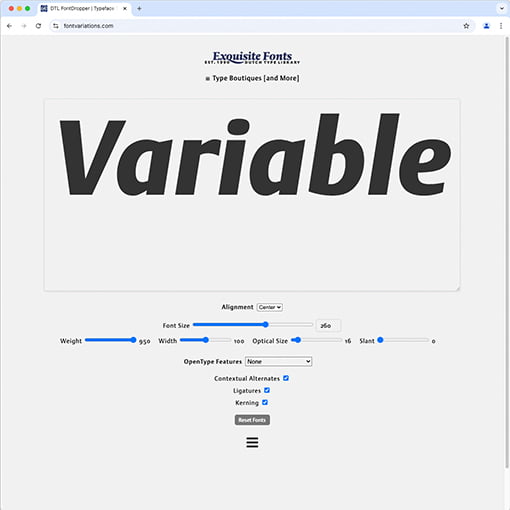
The first edition of dtl FontDropper lets one drop .otf, .ttf, .woff or .woff2 files and then test a range of OpenType Layout features (individually and simultaneously). In addition, there are four sliders for variable fonts, provided that the relevant font supports them. When one uploads a font file with an aforementioned suffix to the tool, it is temporarily stored in the browser’s memory and deleted when the page is reloaded or closed.
Autohinters compared
[Posted: Friday 11 January 2013]
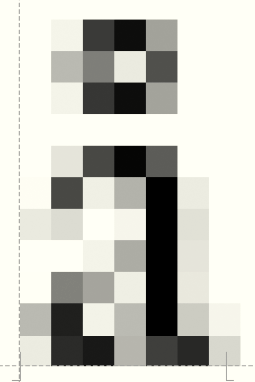
Vernon Adams published a highly interesting in-depth comparison of the stand-alone Open Source ttfautohint tool and the ikarus-based autohinter in dtl Bezier- and IkarusMaster. ttfautohint is programmed by Werner Lemberg, wellknown for his work on the FreeType project.
For a number of illustrations in the document Vernon Adams used dtl OTMaster, which includes the FreeType rasterizer. The outcome of the comparison shows that the quality of both ttfautohint and dtl’s autohinter are comparible, the former somewhat stronger for lighter weights, the latter somewhat better for bolder weights.
Based on Vernon Adam’s research, both autohinters will be further improved.

@font-face is here!
[Posted: Thursday 2 December 2010]
Recently the typography of this site has been improved using @font-face bundles (ttf, eot, woff, svg) of dtl Argo stw (sans serif) and dtl Antares stw (serif) and doing so, we also removed some deprecated xhtml elements. The perfectly crafted dtl fonts appear as harmonically and rhythmically strong on screen as they do in print. Of course, the dtl fonts make typographic refinements on the web possible, such as the application of old-style figures and small caps.
The latest editions of most modern browsers, including Safari, Firefox and Chrome, support the @font-face style property. Unfortunately Internet Explorer 8 doesn’t handle the applicable css3 code correctly (a comma-delimited list of fonts is not supported) and ie 8 only supports the eot format, so Windows users who want to see this web site in full glory should use Firefox, or will have to wait for the official release of Internet Explorer 9. Alternatively the latest platform preview of ie 9 could be installed. Internet Explorer 9 seems to support the @font-face rule properly and on top of that also supports the woff format.
If the new fonts don’t show up immediately in Safari or Chrome by the way, clearing the caches should help (its is a good thing to do this on a regular basis anyway, to ensure that the browsers are working at optimal speed).
The Dutch Type Library is convinced that webfonts especially will become an important part of corporate identities and that the nearing browser-wide support of the @font-face rule will generate a break-thru for webfonts. Of course, the currently partly limited support of the @font-face rule can be circumvented by applying for instance the Cufón format, which is also available from dtl.